


Meet Our Team

Director
Dr. Uri Davidovich
Uri is a senior lecturer at the Institute of Archaeology in the Hebrew University of Jerusalem. His main research interests revolve around landscape and regional archaeology, with particular focus on the development of complex societies in the southern Levant, human exploitation patterns of marginal landscapes (such as caves, cliffs and deserts) and the archaeology of roads and movement.
For over two decades, he has conducted research in the Judean Desert through excavations and surveys. He is the director of the En-Gedi Archaeological Project.


Area D Supervisor
Julian Hirsch
Julian is a PhD candidate in the Institute of Archaeology and the Mandel School for Advanced Studies in the Humanities of the Hebrew University of Jerusalem. He primarily researches anthropocentric culture change in the Early Bronze Age as well as patterns of long-distance exchange through the study of Late Prehistoric beads and pendants. In addition, Julian maintains an active research interest in the history of Anglo-American Biblical Archaeology.
At En-Gedi, he supervises Area D and is enjoying discovering the fascinating world of late Iron Age Judah.

Area Z Supervisor
Yuval Derfner
Yuval is an MA student at the institute of Archeology, the Hebrew University of Jerusalem. His research interests includes human-enviorment relations, site formation processes, geo-archeology and social theory applications in archaeology. Yuval's MA thesis focuses on the production and distribution of specialized chert implements as means of illuminating complex social relations during the Early Bronze Age urbanization.
In the En-Gedi excavations, he serves as the supervisor of Area Z.

Assistant Area Supervisor
Hanni Kolpakchi
Hanni is an undergraduate student in the Institute of Archaeology at the Hebrew University of Jerusalem, specializing in Biblical and Classical archaeology. Her main interests lie in socio-economic relations, with a particular focus on various industries and the impact of international processes on local developments in antiquity. She is also a member of the Tel Hazor excavation team at the Hebrew University.
In the En-Gedi excavations, she serves as an assistant area supervisor.

Assistant Area Supervisor
Shoval Seri
Shoval is an undergraduate student in the Institute of Archaeology at the Hebrew University of Jerusalem, specializing in Biblical archaeology.
In the En-Gedi excavations she serves as a registrar and assistant area supervisor.

Research Assistant
Morasha Rabinowitz
Morasha Rabinowitz graduated from Washington University in St. Louis with degrees in Art History, Archaeology, and Anthropology, and is planning to continue her studies in Israel next year. She specializes in archaeobotany and is interested in anything vaguely relating to ancient plants, but especially textiles and farming practices. Her past work includes research on pastoralist crops in East Africa and cultivation in Classical Greece.
In the En-Gedi excavations she serves as a registrar and assistant area supervisor.

Field Director
Avraham Mashiach
Avraham (Avi) is a PhD candidate at the Institute of Archaeology and the Mandel Scholion Research Center at the Hebrew University of Jerusalem. He completed his M.A. at the Hebrew University, focusing on the archaeology of late Iron Age En-Gedi. His doctoral research examines the historical interactions between the settled regions and desert margins of the southern Levant during the mid-first millennium BCE. His academic interests include intercultural relations, imperial dynamics, archaeology and the Bible, and the social history of the ancient Levant.
In the En-Gedi excavations, Avi serves as a field director.

Area B-C Supervisor
Itay Lubel
Itay is a PhD candidate at the Institute of Archaeology at the Hebrew University of Jerusalem, conducting his doctoral research under a cotutelle framework with the University of Cologne. He is a recipient of the President’s Scholarship for Outstanding Doctoral Students.
He completed his MA at the Hebrew University, focusing on human-environment relations and nomadic mobility in the Negev Highlands during the Iron Age IIa. His doctoral research, titled "Simulating Socio-Ecological Transformations in Marginal Zones: Introduction of Agriculture into Pastoral Systems in the Byzantine Negev," uses computational simulations to investigate how volatile pastoral socio-ecological systems transform under agricultural expansion. His academic interests include human-environment relations in arid zones, spatial archaeology, agent-based modeling (ABM), and the historical transitions of the southern Levant.
In the En-Gedi project, Itay is the supervisor of Area B-C.

Area D Supervisor
Idan Harlev
Idan is an MA student at the Institute of Archaeology, the Hebrew University of Jerusalem. His research focuses on agricultural practices and settlement patterns in agrarian societies, ancient subsistence strategies, and the integration of historical texts to reconstruct aspects of daily life in the past. His MA thesis examines seasonal sites in the settled lands of the Southern Levant, and their role in shaping ancient settlement systems. Idan also serves as a staff member at the Heftziba excavations, which are part of the Jezreel Valley Regional project.
In the Excavations at En-Gedi Idan serves as Area D Superviseor.
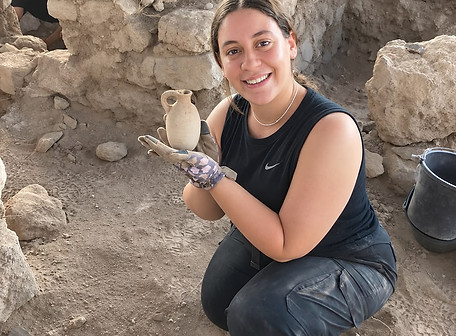
Assistant Area Supervisor
Talia Gian Ovadia
Talia is an MA student at the Institute of Archaeology and the Department of Sociology and Anthropology, the Hebrew University of Jerusalem. Her research interests include protohistoric cultures, the epistemology of archaeological practice, and social theory applications in archaeology. Talia’s MA research brings qualitative methods from the social sciences to the study of archaeology itself, examining the mechanisms through which archaeological knowledge is produced, written and validated. She is a member of the Human Cultural Evolution (HCE) Lab at the Institute of Archaeology and of the Tinshemet Cave excavation project. In the En-Gedi excavations, she serves as an assistant area supervisor.
In the En-Gedi excavations she serves as a registrar and assistant area supervisor.

GIS and drone coordinator
Omri Alon
Omri is an M.A. student at the Institute of Archaeology at the Hebrew University of Jerusalem. His research interests include the archaeology and historical anthropology of the Late Antique to medieval Levant, as well as landscape archaeology. His M.A. research explores the spatial, landscape, and architectural dimensions of early Islamic open-air shrines, commonly known as “open mosques,” in the desert regions of the Negev and Arava. It examines the role of landscape in religious practice, specifically in early Islam. Omri is also a staff member at the Heftziba excavations, part of the Jezreel Valley Regional Project.
At the En-Gedi excavations, he serves as the GIS and drone photography coordinator.
